Display Table of Contents
A solar canopy is a raised photovoltaic structure that generates electricity while sheltering the space beneath it, usually a car park, walkway, or outdoor seating area. Output varies by size and panel specification, but a standard solar carport covering 20 parking bays can produce roughly 50 to 80 MWh per year. This guide compares the best use cases for a solar canopy for schools, apartment complexes, and office car park solar canopy installations. It covers output expectations, planning considerations, and financial returns for each property type.
Key takeaways
- Match canopy tilt angle and inverter sizing to the unique load profile of each property type.
- School staff car parks can offset 30–50% of annual campus electricity consumption.
- Canopies above resident parking in apartment blocks add generation without using limited rooftop space.
- Office car parks achieve the highest self-consumption, since demand aligns with peak solar output.
- Differences in tilt angle and orientation between property types can shift annual yield by 20–40%.
- Free-standing canopies often qualify as permitted development, but listed buildings need formal consent.
- Complete structural and drainage surveys of the car park ground before accepting any installation quote.
How Solar Canopies Fit Different Property Types
Assess daily energy demand and parking layout before choosing a canopy configuration. A solar canopy for schools has a different load profile from one above an office car park, so the structural design, tilt angle, and inverter sizing need to change.
Schools use most electricity between 08:00 and 15:30 on weekdays, then demand drops steeply during holidays. Canopies over staff car parks can offset peak daytime loads directly. Flat-roof canopy frames can also serve as covered outdoor areas for assemblies or break times.
Apartment blocks have split demand: low during working hours and high in the evenings. An office car park solar canopy paired with battery storage can bridge that gap by storing midday generation for residents returning after 17:00. Shared ownership models also let landlords spread costs across leaseholders while meeting EPC upgrade targets.
Source: article content. Values shown are 100 kWp for a 40-bay south-facing office canopy and 30–50% annual consumption coverage for a well-sized school canopy.
Commercial offices align well with canopy generation because electricity use peaks during sunlight hours. A south-facing canopy spanning 40 standard bays can deliver roughly 100–120 kWp, enough to cover a significant share of a mid-sized building’s daytime base load. Integrated EV charging points add tenant value and help future-proof the site against rising workplace charging demand.
Each property type benefits most when canopy size matches on-site consumption rather than simply maximising panel count. Right-sizing the system can shorten payback periods and avoid overloading the grid connection.
Best Use Cases for Solar Canopies on School Campuses
A well-sized solar canopy for schools can generate enough electricity to cover 30–50% of a campus’s annual consumption. Staff and visitor car parks often make the best sites. They sit unused during peak generation hours and do not disrupt playgrounds or sports pitches.
Canopies over bus drop-off lanes protect students during arrival and dismissal. They can also feed surplus generation back into the grid during holidays. When paired with battery storage, the array can shift that surplus to early-morning or late-afternoon peaks. This reduces reliance on grid imports when term resumes.
Live generation dashboards also turn the canopy into a teaching resource. Platforms from providers such as SolarEdge display real-time output, historical trends, and carbon savings. This links directly to GCSE and A-level physics and geography curricula. Schools integrating this data into lessons report stronger engagement with renewable-energy topics and measurable reductions in campus energy costs within the first academic year.
Where Solar Canopies Deliver the Most Value for Apartment Developments
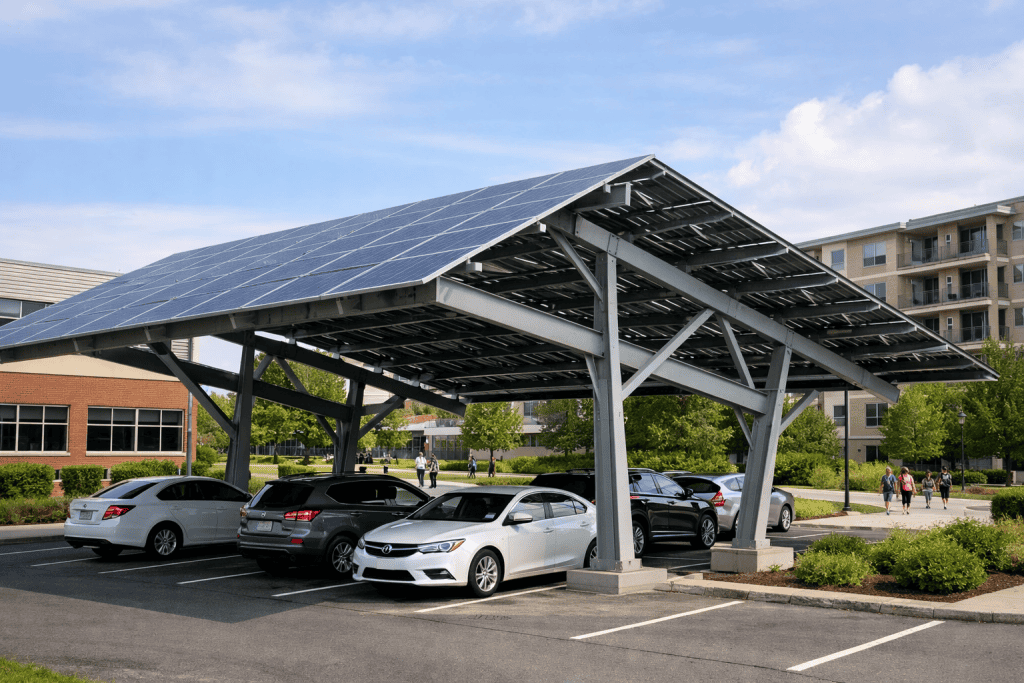
Apartment buildings rarely have enough rooftop space to meet total energy demand. HVAC units and communal amenities take up much of that area. A solar canopy over resident parking adds generation capacity without competing for roof access.
Surface car parks at apartment complexes typically cover 200 to 400 m² per 20 spaces. Panels rated at 180 to 200 Wp per m² can support communal lighting, lifts, and EV charge points. Battery storage can then shift surplus midday production to peak demand after 17:00.
Parking areas beside multi-storey developments can create wind-tunnel effects, which increase uplift forces on the canopy frame. Steel columns and crossbeams must suit the site’s wind exposure zone. Installation often requires mobile cranes or telehandlers sourced through a specialist lifting equipment supplier. Soft ground may require piled foundations rather than pad footings.
The financial case focuses on cutting communal electricity bills and offering residents subsidised EV charging. Surplus export revenue creates a second income stream and helps offset service charges over a 20 to 25 year canopy lifespan.
Office Car Park Solar Canopy Applications and Site Priorities
Office buildings use electricity during the same hours that solar panels generate it. That makes an office car park solar canopy one of the most efficient self-consumption setups available. Daytime demand from lighting, HVAC, servers, and workstations aligns with peak solar carport output, which cuts grid exports and increases savings per kilowatt-hour.
Map the car park’s unshaded area and orientation first. In the UK, south-facing bays at a 10 to 15° tilt deliver the strongest annual yield. Commission a structural survey early, because canopy columns must clear existing drainage, cabling routes, and traffic flow. Plan EV charging at the design stage rather than retrofitting it later, since trenching costs double once the canopy is built.
Size the array around base-load demand, which is the minimum electricity drawn continuously by security systems, server rooms, and ventilation. Output beyond base load exports at lower tariffs, which weakens the financial case. A qualified installer can model half-hourly consumption against projected output and identify the right capacity.
A minimum clearance of 2.4 m suits standard vehicles, though delivery bays and emergency routes may need 4.5 m or more. Confirm planning requirements with the local authority before procurement. Pair the canopy with a battery only if the building carries significant evening or weekend load. Otherwise, storage payback stretches well beyond ten years.
Solar Carport Output Factors That Change by Property Type
Roof pitch, orientation, and shading hours vary sharply between a single-storey school hall and a multi-level office block. That difference can alter annual kilowatt-hour yield by 20–40%. A flat school canopy at 10° tilt in southern England produces less per panel than a 15–20° office carport oriented due south, even with identical hardware.
Panel density changes by property type as well. Schools need wider column spacing for bus lanes and emergency access, which cuts panels per square metre. Apartment canopies face height restrictions that limit tilt angles. Office sites have fewer constraints, so they can fit panels more tightly and optimise inverter string lengths for higher solar carport output.
Electricity tariff structure matters as much as generation capacity. Schools on half-hourly metered contracts benefit from export during holidays. Offices on fixed-rate commercial tariffs gain more from direct self-consumption. Apartment developments using a power purchase agreement distribute savings across communal and tenant meters differently. Modelling each property’s load profile against local irradiance data with PVGIS gives far more accurate payback estimates than applying a single output assumption across all three property types.
Planning, Access, and Funding Considerations Before Installation
Check planning status before you request quotes. Free-standing canopies in school grounds and office car parks often qualify as permitted development, but canopies attached to listed buildings or within conservation areas almost always need formal consent. Contact the local planning authority early and avoid costly redesign.
Complete structural surveys before you accept any quote. Car park ground may contain drainage runs, fibre-optic ducts, or gas mains that restrict foundation placement. A geotechnical report typically costs £500 to £1,500 and can prevent expensive surprises during construction.
Funding routes differ by property type. Schools can access the Salix Finance interest-free loan scheme or the Public Sector Decarbonisation Scheme. Apartment developers may recover costs through service charges, while offices often use capital expenditure or power purchase agreements. Understanding how long solar panels take to pay for themselves helps set realistic payback expectations.
Apply for grid connection approval from the local Distribution Network Operator (DNO) once system sizing is confirmed. Approval can take 30 to 90 days for systems above 3.68 kW, so submit the G99 application early.
Frequently Asked Questions
Which school sites benefit most from a solar canopy installation?
Large, open car parks with little shading deliver the highest solar carport output for schools. South-facing parking areas with consistent daytime occupancy increase self-consumption of generated electricity. A solar canopy for schools works especially well on flat, unobstructed tarmac, which can reduce structural preparation costs and simplify planning approval.
How much electricity can a solar carport canopy generate for an apartment block or office site?
Output depends on canopy size, panel efficiency, orientation, and local irradiance. In the UK, a 50-space office car park solar canopy fitted with 100 kWp of panels typically generates 85,000–95,000 kWh per year. Apartment blocks with fewer spaces produce proportionally less, but they can still offset a significant share of communal electricity demand.
What makes an office car park solar canopy a strong fit for commercial properties?
Install an office car park solar canopy to generate power during peak daytime demand, when commercial electricity rates are highest. Most office car parks have a large, unshaded footprint, which helps maximise solar carport output. Employees get covered parking, while the business offsets energy costs and strengthens its sustainability credentials.
How do planning, shading, and parking layout affect solar canopy performance by property type?
Shading from nearby buildings or trees can cut solar carport output more than orientation alone. Schools often deal with tall perimeter fencing or mature trees, while office car park solar canopy arrays must work around multi-storey structures. Parking bay dimensions also shape column placement, which then affects panel tilt angle and total generation capacity across every property type.
Which factors matter most when comparing solar canopies for schools, apartments, and offices?
Roof access, daily occupancy patterns, and available car park area shape the decision. A solar canopy for schools needs safeguarding-compliant design and term-time load profiles. Apartments need shared-billing structures. Office car park solar canopy installations prioritise peak weekday solar carport output to offset daytime demand.