Display Table of Contents
Your boiler affects comfort, energy bills, and carbon emissions. Yet many UK homes run systems that waste heat through poor controls, ageing parts, or incorrect settings. This guide explains what boiler efficiency means, how to spot common signs of underperformance, and which checks you can do at home before calling an engineer.
You will also learn how efficiency links to boiler type, maintenance, and heating habits, so you can reduce waste without sacrificing warmth.
Key takeaways
- Boiler efficiency shows how much fuel becomes usable heat, not wasted energy.
- Modern condensing boilers often reach 90%+ efficiency by reusing flue heat.
- Older non-condensing models can run far less efficiently, raising bills and emissions.
- Check the boiler’s ErP label and seasonal efficiency rating for a realistic comparison.
- Correct flow temperature and effective controls can improve efficiency without replacing the boiler.
- Annual servicing and clean radiators help maintain performance and prevent efficiency losses.
What boiler efficiency means and how UK ratings work
Boiler efficiency describes how much of the fuel a boiler uses becomes useful heat for radiators and hot water. A boiler that runs at 90% efficiency turns about 90% of the gas into heat, while the rest leaves through the flue as waste. Higher efficiency usually means lower running costs for the same heat demand, although insulation, controls and user settings also affect bills.
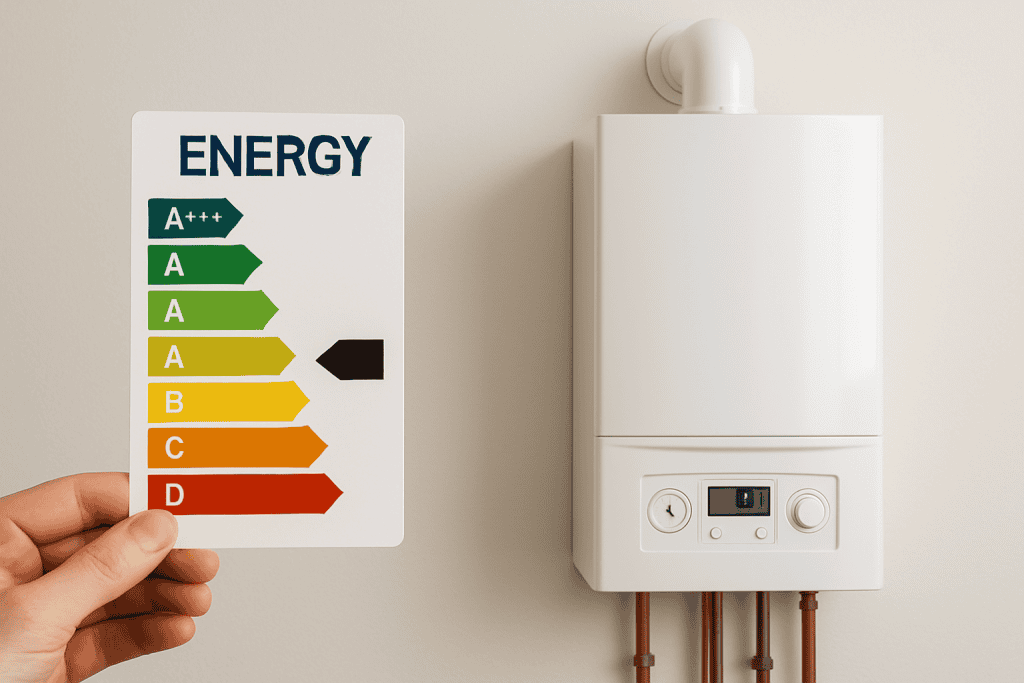
In the UK, boiler efficiency often appears as a seasonal rating. Modern product literature may refer to ErP (Energy-related Products) space-heating efficiency, shown as a percentage and an energy class. The ErP scheme comes from the European Commission and remains used on UK boiler labels; the label grades products from A+++ to G and reflects typical performance across a heating season rather than a single test point. For official background, see the European Commission energy labelling and ecodesign pages.
You may also see older SEDBUK figures on documents for existing installations. SEDBUK stands for Seasonal Efficiency of Domestic Boilers in the UK and expresses a similar idea: expected efficiency over a year of normal use.
How to check your boiler’s efficiency at home
You can estimate boiler efficiency at home by combining simple checks with basic record keeping. These steps will not replace a professional combustion test, yet they can highlight poor settings, avoidable heat loss, or signs that a service is due.
- Find the model details and paperwork. Check the boiler badge, manual, or commissioning sheet for the model name and any stated efficiency figure. If the manual is missing, search the manufacturer site using the exact model number.
- Check flow temperature settings. For many modern condensing boilers, a lower central-heating flow temperature helps the boiler condense and recover more heat from flue gases. As a practical guide, many homes can run efficiently with radiator flow set around 55–60°C, provided rooms still reach the target temperature.
- Review your controls. Confirm that a programmer, room thermostat, and thermostatic radiator valves work as intended. Poor control can waste heat even when the boiler itself performs well.
- Look for short cycling. If the boiler fires for a minute or two, stops, then repeats often, efficiency usually drops. Common causes include an oversized boiler, incorrect settings, low system water volume, or a faulty sensor.
- Inspect for heat loss. Feel exposed pipework near the boiler and hot water cylinder. Warm pipes in unheated spaces often indicate missing insulation.
To add a simple, numbers-based check, compare gas use against heat demand. Record weekly gas meter readings and note average outdoor temperature and heating hours. If gas use stays high during mild weeks, controls or flow temperature may need adjustment.
Arrange a Gas Safe service if you notice sooting, unusual smells, frequent lockouts, or a yellow flame. You can verify an engineer’s registration on the Gas Safe Register. A service can include flue-gas analysis, which provides the clearest picture of real-world combustion efficiency.
Common causes of poor boiler efficiency and warning signs
Poor boiler efficiency often starts with incomplete combustion, which wastes gas and raises carbon monoxide risk. A blocked flue terminal, low gas pressure, or a faulty burner can cause that problem. Limescale and sludge also reduce heat transfer; hard-water areas can fur up the heat exchanger, while magnetite (black sludge) restricts flow through radiators. Worn seals, a sticking diverter valve, or a failing fan can force longer run times for the same heat output. Incorrect system pressure and trapped air can also make the boiler cycle on and off, which increases fuel use.
Watch for warning signs such as rising bills with no change in use, slow warm-up, frequent cycling, noisy kettling, or radiators that stay cool at the bottom. Yellow flames, sooting, or persistent pilot issues need urgent attention. If a carbon monoxide alarm sounds, follow Gas Safe Register guidance and arrange an inspection by a registered engineer.
Practical steps to improve efficiency and cut heating bills
Start with your controls. Set a timed schedule that matches occupancy, then use the room thermostat to hold a steady temperature rather than frequent manual changes. If the boiler supports weather compensation or load compensation, ask a Gas Safe engineer to enable and set the feature, as it can reduce cycling and improve comfort. Keep the flow temperature as low as practical, since condensing boilers run most efficiently when the return temperature stays cool; many homes can run space heating at about 55°C once radiators and balancing suit the property.
Next, reduce heat loss from the system. Bleed radiators when cold spots appear, then check pressure and top up only to the manufacturer’s range. Fit thermostatic radiator valves where suitable and avoid covering radiators with furniture or long curtains. Insulate accessible heating pipes, especially in lofts and garages, and set the hot water cylinder thermostat to around 60°C to limit heat loss while controlling legionella risk.
Arrange annual servicing with a registered engineer and keep the benchmark log updated. Use the Gas Safe Register to find a qualified professional. During a service, request checks on combustion, condensate drainage, and system cleanliness, as these factors often drive avoidable fuel use.
When to repair, upgrade, or replace your boiler in the UK
Choose repair when the boiler still meets your heat demand, the fault stays isolated (such as a pump, fan, or diverter valve), and the appliance has a solid service record. A qualified engineer can confirm safe combustion and restore performance; arrange Boiler Servicing and Repair if you notice repeated lockouts, unusual noises, or rising gas use without a change in habits.
Plan an upgrade when the boiler works but wastes energy due to limited controls or poor modulation (the ability to vary heat output). Improving controls can reduce cycling and improve comfort, yet some older models cannot support modern optimisation features. Consider your property plans as well; a loft conversion or extra bathroom can push an older system beyond its design.
Replace the boiler when breakdowns become frequent, parts turn costly or hard to source, or the unit cannot run reliably in condensing mode. Age alone does not decide, although many boilers become less economical to keep after 10–15 years, especially if efficiency stays low despite servicing. Safety concerns also justify replacement; any signs of flue issues, persistent sooting, or carbon monoxide alarms require urgent professional attention.
Frequently Asked Questions
How can a UK homeowner check a boiler’s efficiency rating and what does the ErP label mean?
Check the boiler’s efficiency rating on the ErP (Energy-related Products) label, usually on the appliance, in the manual, or on the installer’s paperwork. The ErP label shows an energy class (A+++ to G) and a seasonal space-heating efficiency percentage. Higher classes and percentages indicate better efficiency and lower running costs.
What boiler efficiency level should you expect from an older non-condensing boiler compared with a modern condensing boiler?
An older non-condensing boiler often achieves about 60–75% efficiency, so more heat escapes through the flue. A modern condensing boiler typically reaches about 90–94% efficiency by recovering heat from waste gases. Actual performance varies with boiler condition, correct sizing, and regular servicing.
Which signs suggest your boiler is running inefficiently, such as higher gas bills or uneven heating?
Rising gas bills without higher use often indicate poor boiler efficiency. Other signs include uneven room temperatures, radiators that stay cool at the top, frequent cycling on and off, longer heat-up times, unusual noises, yellow or flickering flames, repeated pressure drops, and regular breakdowns. Persistent condensation, leaks, or a pilot light that will not stay lit also suggest inefficiency.
How much can boiler servicing, correct system pressure, and radiator balancing improve heating efficiency?
Annual servicing can improve efficiency by around 5–10% by restoring safe combustion and clean heat transfer. Correct system pressure helps water circulate properly, reducing pump strain and cold spots. Radiator balancing can cut heat loss and shorten warm-up times, often saving a further 5–15% in poorly balanced systems, depending on property size and controls.
When does replacing a boiler become more cost-effective than repairing it for improved efficiency?
Replacing a boiler often becomes more cost-effective when the unit is over 10–15 years old, needs frequent repairs, or shows a clear drop in efficiency (for example, higher gas bills for the same heating). Consider replacement if a repair costs more than 30–50% of a new boiler, or if key parts fail.