Display Table of Contents
Smart thermostats promise lower heating bills by matching boiler run-time to occupancy and schedules. In the UK, where space heating accounts for roughly 60% of household energy use, small efficiency gains can translate into meaningful savings. Typical devices cost about £150–£250, with professional installation often adding £80–£200. This guide examines what savings look like in practice, which homes benefit most, and the factors that can erase the expected payback.
Key takeaways
- Smart thermostats cut bills most in homes with irregular daily heating patterns.
- Typical UK savings sit around 5–15% when schedules and zoning are used.
- Homes already using tight programmer schedules often see smaller, marginal savings.
- Upfront costs usually range £150–£300, plus £60–£120 for professional installation.
- Geofencing and learning modes can backfire if occupancy detection proves unreliable.
- Boiler compatibility matters; older systems may need extra controls or wiring changes.
- Best results come from lower flow temperatures and shorter, targeted heating periods.
How smart thermostats reduce heating costs in UK homes
Space and water heating accounted for 63% of household energy use in the UK in 2023, making heating control the largest lever for bill reduction (UK Government: Energy Consumption in the UK). Smart thermostats cut costs by reducing wasted heat, not by making boilers more efficient. The savings come from tighter temperature control, shorter heating run-times, and fewer hours heating empty rooms.
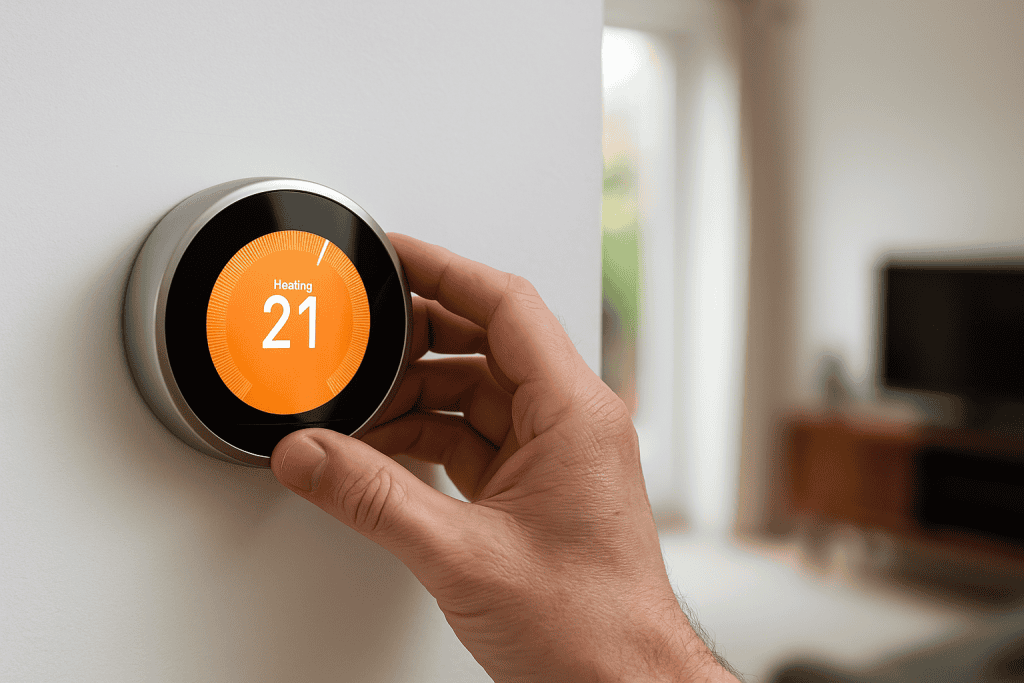
A key mechanism is automatic scheduling and set-back temperatures. Dropping the thermostat by 1°C can reduce heating energy use by about 10% (U.S. Department of Energy). In a UK context, that matters because many homes still heat to 20–21°C for long periods; moving to 19°C for occupied hours and 16–18°C overnight often trims gas use without changing comfort. Smart controls make those set-points consistent, which reduces “manual override” drift that typically pushes temperatures upwards over a winter.
Smart thermostats also use zoning and occupancy signals to avoid heating unused areas. If a household reduces heating by 2 hours per day across the main heating season, the impact compounds quickly because boilers run hardest during morning warm-up and early evening peaks. Some systems also use weather compensation and learning algorithms to start heating later on milder days, which can cut short-cycling and reduce run-time minutes per day.
The financial outcome depends on fuel price and baseline behaviour. Ofgem’s price cap for a typical dual-fuel household stood at £1,928 per year from 1 January to 31 March 2025, down from £2,074 in the previous quarter (Ofgem). If heating represents roughly 60% of annual energy spend, a 10% reduction in heating use can translate into about 6% off the total bill. For households that already use strict schedules, savings often sit at the lower end; homes with irregular occupancy and manual controls usually see the clearest gains. For control options and compatibility, see what are the best smart heating controls.
What UK households can realistically save: evidence, assumptions, and payback periods
A semi-detached home in Leeds spends £1,600 a year on gas for space heating and hot water. After fitting a smart thermostat and using schedules plus geofencing, the household cuts heating run-time by about 10%. That drops annual gas spend by roughly £160, assuming tariffs and usage stay similar.
Evidence suggests that scale of saving is plausible, but not guaranteed. Ofgem sets the UK price cap, and as of 1 January to 31 March 2026 the typical dual-fuel bill under the cap sat at £1,928 per year for a household with typical consumption. When heating drives most winter spend, a 5–12% reduction in heating energy can translate into meaningful cash savings, especially in homes with irregular occupancy.
Payback depends on purchase price and how actively the household uses the features. A £180 thermostat saving £120 per year pays back in about 18 months; the same device saving £60 per year takes 3 years. Installation can shift the maths: a £90 professional fit extends payback by 9–18 months.
- Best fit: variable schedules, frequent empty periods, and rooms that overheat by 1–2°C.
- Lower savings: already disciplined manual control and constant occupancy.
For households comparing options, what are the best smart heating controls provides a practical shortlist and feature checklist.
Compatibility and installation in the UK: boilers, heat pumps, and control standards
A smart thermostat can either integrate cleanly with an existing UK boiler system or require extra hardware and wiring changes. Option A suits most combi and system boilers with standard on/off or OpenTherm control. Option B applies to heat pumps and mixed systems, where compatibility with weather compensation, low flow temperatures, and zoning matters more than app features.
| UK heating setup | Typical control standard | Installation complexity | Practical implication |
|---|---|---|---|
| Combi boiler (radiators) | On/off relay or OpenTherm | Low to medium (often 1–3 hours) | Best results come from stable schedules and correct boiler modulation. |
| System boiler + hot water cylinder | Two-channel (CH + HW) control | Medium (wiring centre and cylinder stat) | Hot water timing and cylinder temperature settings affect savings. |
| Air-source heat pump | Manufacturer controls; weather compensation | Medium to high (system-specific) | Over-aggressive setbacks can raise running costs and reduce comfort. |
Key differences centre on control standards and installer competence. OpenTherm can modulate boiler output, while simple relay control cycles the boiler on and off. For heat pumps, the Department for Energy Security and Net Zero continues to position low-temperature heating as standard practice, which makes correct control strategy critical.
Practical implications are straightforward: confirm compatibility before purchase, budget for professional fitting, and prioritise controls that match the system type. If the property uses a cylinder or zoning, reviewing what are the best smart heating controls helps avoid paying for features that cannot be used.
When smart thermostats do not save money: common pitfalls and how to avoid them
Smart thermostats fail to save money when households pay for features but do not change heating behaviour. The most common issue is leaving a high setpoint in place all day, which can add 5–10% to heating use compared with a 1°C reduction, depending on the home’s heat loss. A second pitfall is poor zoning: heating unused rooms for 6–8 hours a day can erase the typical 10% run-time reduction seen in well-configured homes.
The solution is to treat the thermostat as a control system, not a gadget. Set a realistic comfort temperature, schedule heat only when rooms are occupied, and use room-by-room control where the pipework allows it. If the system supports modulation (for example OpenTherm), enable it to reduce boiler cycling and stabilise flow temperatures.
Start by reviewing a full week of heating graphs, then tighten schedules in 30–60 minute steps. Re-check gas use after 14 days using smart meter data or bills. For control options, see what are the best.
Frequently Asked Questions
How much can a smart thermostat reduce annual gas heating bills for a typical UK household?
For a typical UK household, a smart thermostat can cut annual gas heating bills by about 8–12% when used with schedules, zoning and occupancy features. On a £900–£1,200 yearly gas heating spend, that equals roughly £70–£140 saved per year. Savings fall if the home already uses tight time controls.
Which UK heating systems and boiler types work best with smart thermostats?
Smart thermostats work best with gas combi boilers using standard on/off or OpenTherm modulation, and with system boilers feeding radiators via motorised zone valves. They also suit heat pumps when the controller supports weather compensation and low flow temperatures (typically 35–45°C). Electric storage heaters and older oil/LPG boilers often need specialist controls.
How do smart thermostats use zoning and occupancy detection to cut heating costs in UK homes?
Smart thermostats cut UK heating costs by using zoning to heat only occupied rooms and occupancy detection (motion, geofencing, or phone presence) to reduce setpoints when nobody is home. Heating a single zone instead of a whole house can cut heated floor area by 30–60%, while setback schedules typically lower temperatures by 1–3°C for 6–10 hours daily.
What are the upfront costs, installation options, and typical payback periods for smart thermostats in the UK?
In the UK, smart thermostats typically cost £120–£250, with optional professional installation at £80–£150; many households fit them DIY in 30–90 minutes. If a smart thermostat cuts heating use by 8–12%, a home spending £1,200–£1,800 per year on gas could save £96–£216 annually. Typical payback is 1–3 years.
Do smart thermostats increase electricity use, and does that offset heating savings under UK energy tariffs?
Smart thermostats use little electricity: typically 1–3 W continuously, or about 9–26 kWh per year. Under a typical UK unit rate of 22–30p/kWh (2025–2026), that costs roughly £2–£8 annually. Heating savings usually exceed this, because space heating accounts for about 60% of UK household energy use.