Display Table of Contents
Electricity prices in the UK vary by time of day, and shifting appliance use can cut bills without reducing comfort. On time-of-use tariffs, off-peak rates often run overnight for 4–7 hours, with peak pricing concentrated in early evenings. As of 2025, the typical household uses about 2,700 kWh of electricity per year, so small timing changes can add up. This guide explains the cheapest time windows and which appliances benefit most.
Key takeaways
- Off-peak electricity usually runs overnight, often around 00:30–07:30 on Economy 7.
- Time-of-use tariffs can make late-night laundry and dishwashing noticeably cheaper per kWh.
- Peak pricing typically hits early evenings, so avoid tumble dryers and ovens then.
- Electric vehicle charging costs less when scheduled into off-peak or super off-peak windows.
- Smart meters and supplier apps show half-hour rates, helping you shift high-load appliances.
- Batch cooking and using residual oven heat can cut peak-time electricity consumption.
How UK electricity pricing works: standard tariffs, Economy 7, and smart time-of-use rates
In January 2026, the typical UK household paid 24.5p per kWh for electricity under the Ofgem price cap (direct debit), which sets a benchmark for most standard variable tariffs. Standard tariffs charge a single unit rate all day, so appliance timing changes total use rather than the price per kWh. As a result, shifting a 2.0 kWh dishwasher cycle saves little on a flat rate, but cutting consumption still reduces cost.
Economy 7 uses two rates: a cheaper night rate for 7 hours and a higher day rate. Many meters schedule the off-peak window roughly between 23:00 and 06:00, although times vary by region and meter settings. If the night unit rate sits 40–60% below the day rate, running a 3.0 kW tumble dryer for 1 hour overnight can cut that cycle cost by several pence compared with daytime use, while electric storage heating benefits most because it can charge for multiple hours.
Smart time-of-use tariffs price electricity in half-hour blocks, reflecting wholesale costs and network demand. National demand often peaks around 16:00–19:00, when prices tend to rise, while overnight periods frequently sit lower. Some smart tariffs also offer fixed “off-peak” blocks, such as 4 hours overnight, which can materially reduce the cost of EV charging or immersion heating. For practical steps on reducing consumption alongside tariff choice, see How To Reduce Electricity Bills?.
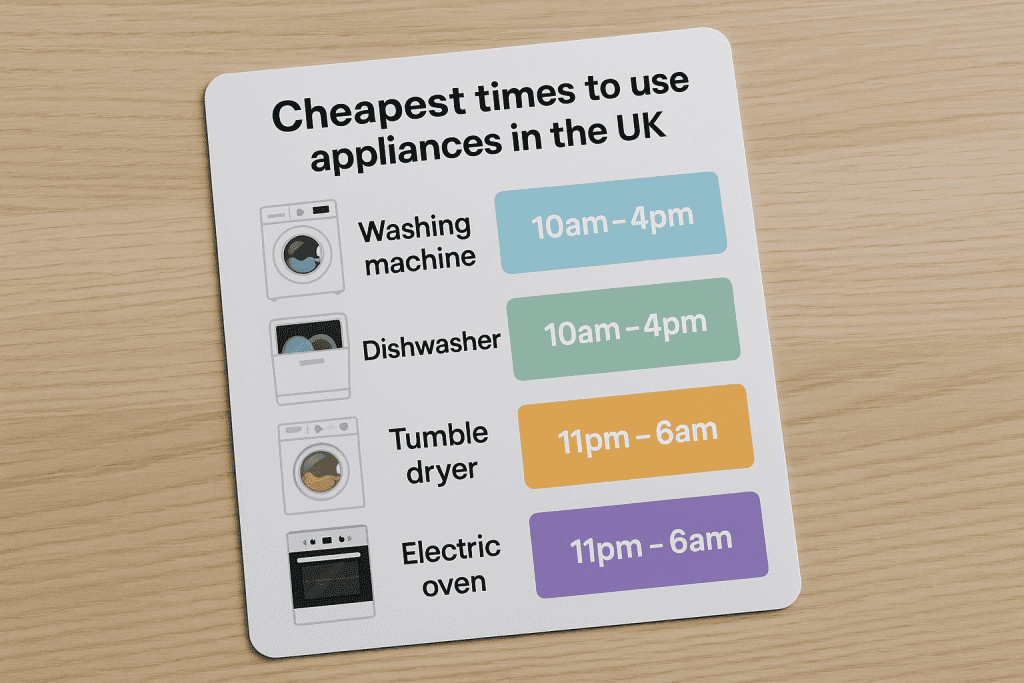
Cheapest hours for appliance use on common UK time-of-use tariffs (with typical off-peak windows)
At 21:30 on a winter weekday, a household runs a 2.0 kWh dishwasher cycle and a 3.0 kWh tumble-dryer load back-to-back. On a smart time-of-use plan, that timing can cost materially more than waiting until the off-peak window starts, because evening demand typically drives the highest unit rates. If the peak unit rate sits 15–25p per kWh above off-peak, the same 5.0 kWh routine can cost 75p–£1.25 extra.
On common UK time-of-use tariffs, the cheapest hours usually sit overnight. Economy 7 typically provides 7 off-peak hours, often starting around 23:00–00:30 and ending around 06:00–07:30, but the exact times vary by region and meter configuration. Smart time-of-use tariffs can also discount overnight hours, while charging a premium during the early evening peak (often 16:00–19:00). Some suppliers also apply a shoulder rate either side of the peak, which can still beat the daytime unit price.
- Economy 7 (legacy off-peak): Typical off-peak window 23:00–06:00 or 00:30–07:30 (7 hours). Some areas use split windows, such as 22:30–00:30 and 02:30–07:30.
- Economy 10 (less common): Often 10 hours off-peak split across afternoon and overnight, for example 13:00–16:00 plus 20:00–07:00 (times vary by region).
- Smart time-of-use: Off-peak commonly falls overnight (for example 00:00–05:00), with peak pricing frequently concentrated around 16:00–19:00. Suppliers set these windows, so check the tariff schedule in the app or contract.
Returning to the example, shifting 5.0 kWh of appliance use from a peak period to an off-peak rate can save several tens of pence per day. A 20p per kWh peak-to-off-peak gap equates to about £1.00 saved per week for that single routine (5.0 kWh × £0.20). Over a month, that routine alone can trim roughly £4–£5, depending on how many days it runs.
Apply the same logic to high-consumption appliances: tumble dryers (2–4 kWh per load), dishwashers (1–2.5 kWh per cycle), and electric vehicle charging (often 7–30 kWh per session). Confirm your exact off-peak hours with your supplier or meter setup, and use delay-start features to schedule runs automatically. If a meter uses split-rate switching, check whether the changeover follows GMT or BST to avoid an hour of mis-timed use. For broader bill-cutting tactics beyond timing, see How To Reduce Electricity Bills?
High-consumption appliances: when to run washing machines, tumble dryers, dishwashers, and immersion heaters
Running high-consumption appliances on a flat-rate tariff versus a time-of-use tariff produces a different outcome. With a flat rate, timing does not change the unit price, so a 2.0 kWh dishwasher cycle costs the same at 18:00 as at 01:00. With Economy 7 or smart time-of-use pricing, shifting use into off-peak hours can cut the unit rate by 15–25p per kWh, which turns appliance timing into a direct saving.
| Appliance | Typical energy per use | Best timing on time-of-use tariffs | Why it matters |
|---|---|---|---|
| Washing machine | 0.6–1.2 kWh per cycle | Off-peak window (often overnight) | Heating water drives most cost; cold washes reduce kWh. |
| Tumble dryer | 2.5–4.5 kWh per load | Off-peak, or avoid peak evenings | A single load can cost £0.75–£1.25 more at peak if rates differ by 25p/kWh. |
| Dishwasher | 1.0–2.0 kWh per cycle | Off-peak with delay start | Smaller kWh than drying, but frequent use compounds savings. |
| Immersion heater | 3 kW element; 1 hour ≈ 3.0 kWh | Heat water during off-peak, then store | One hour at a 25p/kWh spread changes cost by about 75p. |
The practical implication is simple: prioritise shifting the tumble dryer and immersion heater, because each session often uses 3–5 kWh. Use delay-start features and avoid stacking multiple loads in the early evening, when demand-driven pricing tends to rise. For broader strategies beyond timing, see How To Reduce Electricity Bills?.
How to find your cheapest times: smart meter data, supplier apps, and half-hourly unit rates
Many households assume off-peak means “after midnight”, then discover the cheapest window starts earlier or shifts by season. On half-hourly tariffs, unit rates can vary by 10–30p per kWh between the evening peak and the overnight low, so running a 3.0 kWh tumble-dryer load at the wrong time can add 30p–90p to a single cycle.
You can find your cheapest times by combining three inputs: smart meter half-hourly reads, your supplier’s app, and the tariff’s published rate schedule. When those three match, you have a reliable plan for scheduling high-consumption loads without guessing.
Step-by-step: confirm your lowest unit-rate windows
- Check whether you have half-hourly settlement. If your supplier bills from half-hourly data, the app or online account usually shows usage by 30-minute block. If the account only shows daily totals, request half-hourly reads from the supplier.
- Open your supplier app and locate unit rates by time. Time-of-use plans publish a rate card with start and end times. Save a screenshot for winter and summer if the plan changes seasonally.
- Validate with your smart meter data. Compare three recent days and identify the lowest-priced 2–4 hour block. If the tariff has dynamic pricing, repeat this check weekly, because the cheapest half-hours can move.
- Translate rates into appliance costs. Multiply the appliance’s kWh per cycle by the unit rate. Example: a 2.0 kWh dishwasher cycle costs 18p at 9p/kWh, but 70p at 35p/kWh.
What results to expect
If you shift 10 kWh per week from peak to off-peak and the gap averages 20p per kWh, you save about £2 per week, or roughly £104 per year. Households that run an immersion heater (typically 3 kW) for 2 hours overnight can move 6 kWh per day; at a 15p per kWh gap, that change saves about 90p per day.
For broader reductions beyond timing, use How To Reduce Electricity Bills? to cut kWh as well as unit-rate exposure.
Reducing bills without shifting everything: automation, load planning, and safety considerations
As of January 2026, the typical electricity unit rate under the Ofgem price cap sat at 24.5p per kWh for direct debit customers (Ofgem). That benchmark matters because you can reduce costs without moving every task to the middle of the night: you only need to shift the highest-load minutes. On time-of-use pricing, a 10–30p per kWh spread between peak and overnight lows means that timing a 3.0 kWh dryer load can change the bill by 30p–90p per cycle.
Automation makes the shift practical. Use appliance delay-start, smart plugs, or built-in timers to schedule fixed loads into your cheapest window while keeping daytime routines intact. A simple load plan helps: run one high-consumption appliance at a time, then stagger the next start by 30–60 minutes to avoid stacking demand. That approach reduces the risk of nuisance trips and can lower peak draw, which matters in homes with 60–100A main fuses.
Safety should set the boundaries. Avoid running tumble dryers unattended overnight, keep filters clear, and maintain airflow around the appliance. For immersion heaters, confirm the cylinder thermostat and overheat cut-out operate correctly, and set water temperature to around 60°C to limit legionella risk while avoiding excessive heat loss. If you want broader consumption cuts alongside timing, review How To Reduce Electricity Bills?.
Frequently Asked Questions
What time of day is electricity typically cheapest in the UK on a standard variable tariff?
On a standard variable tariff, electricity usually costs the same all day because suppliers set a single unit rate and standing charge. As a result, there is typically no “cheapest time” to run appliances. Lower-cost hours mainly apply to time-of-use tariffs such as Economy 7, which often price overnight periods (commonly about 7 hours) more cheaply.
How do Economy 7 and Economy 10 off-peak hours work, and when do they usually apply?
Economy 7 and Economy 10 are time-of-use electricity tariffs with cheaper unit rates during set off-peak windows. Economy 7 provides 7 off-peak hours, usually overnight (commonly 23:00–06:00 or 00:00–07:00). Economy 10 provides 10 off-peak hours, often split between overnight and daytime blocks. Times vary by region, meter, and daylight saving.
Which UK energy tariffs offer half-hourly pricing, and how can households use them to run appliances more cheaply?
UK half-hourly tariffs include Octopus Energy Agile, Octopus Tracker (daily price), EDF Energy Tracker, E.ON Next Pledge, and British Gas PeakSave. Households can cut costs by using a smart meter to shift high-load appliances (washing machine, tumble dryer, dishwasher) into the cheapest half-hours, often overnight or mid-afternoon. Use timers and app price alerts.
What are the cheapest times to run high-consumption appliances such as washing machines, tumble dryers, and dishwashers in the UK?
For most UK households, the cheapest time to run washing machines, tumble dryers, and dishwashers is overnight on an Economy 7 tariff, typically 7 hours between about 23:00 and 08:00 (times vary by region). On smart time-of-use tariffs, the lowest rates often fall between 00:00 and 05:00. Avoid 16:00–19:00.
How can households check their smart meter or supplier app to identify the lowest-cost time slots for appliance use?
Open the in-home display or supplier app and view half-hourly usage and tariff rates. Switch to the “time-of-use” or “unit rate by time” screen, then compare prices across a full day. Identify the cheapest 2–4 consecutive slots and schedule high-load appliances (2–3 kW) within those periods.